Station 2 · Myopia
Terra Incognita
📍 Kreuzung Nordbahnstraße / Lassallestraße, 1020 Wien
Open in Google Maps — Kreuzung Nordbahnstraße
Background
On your way here, you passed Lassallestraße — a row of large-scale office blocks. That strip was the first piece of the Nordbahnhof brownfield to change hands. In 1979, the Austrian Federal Railways (ÖBB) released a 200-metre-wide strip along Lassallestraße for development. But actual construction only began in the 1990s, driven by Vienna's bid for the 1995 World Expo — a joint project with Budapest that was ultimately rejected by Viennese citizens in a 1991 referendum (65% voted against). The Expo never happened, but the development momentum it generated continued.
The result: a row of office blocks. No residential buildings behind them. No shops at street level. A critics' initiative later described it as a development that "forgot about the future behind it."
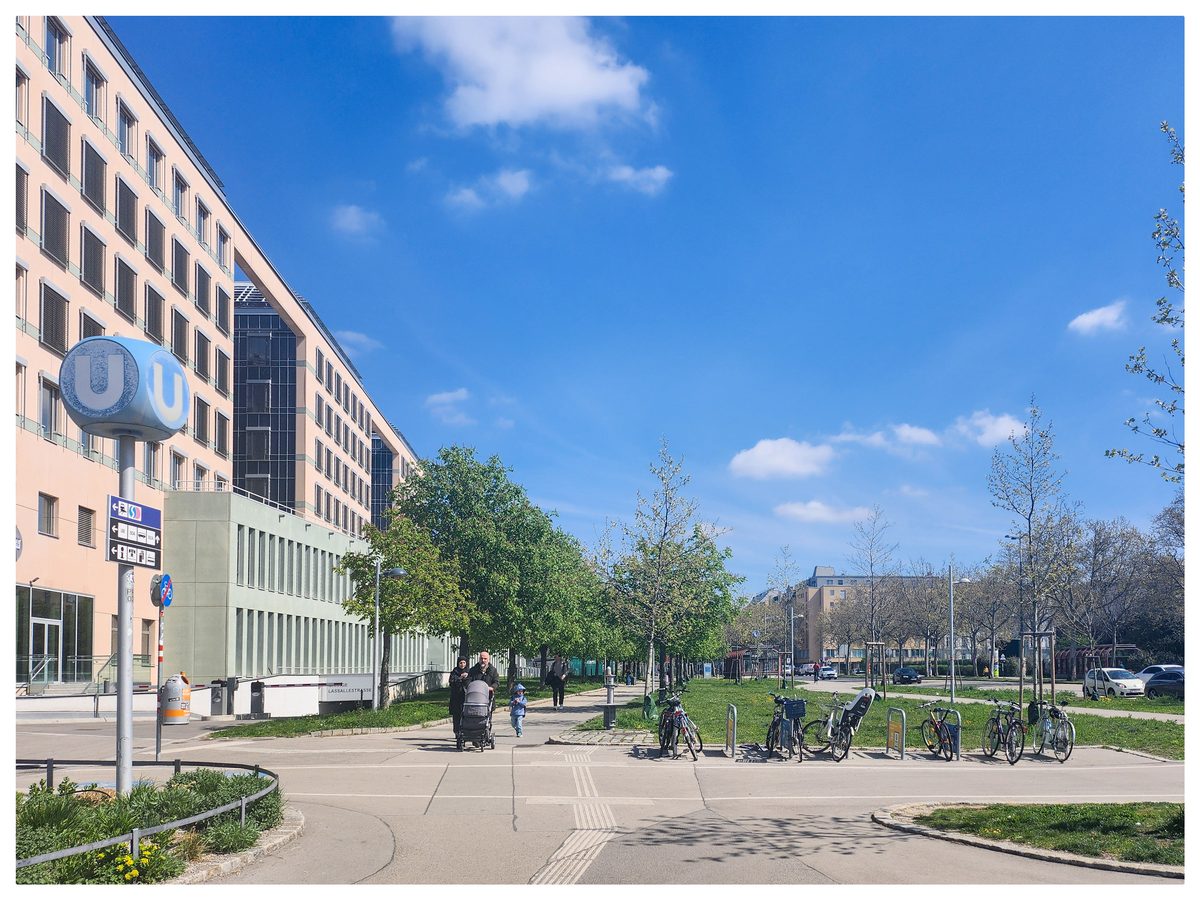
The first master plan for the full area was approved in 1994 — by which time the office strip was already taking shape. A textbook case of what happens when a single-use zone is built without considering the neighbourhood it will one day be part of.
The site
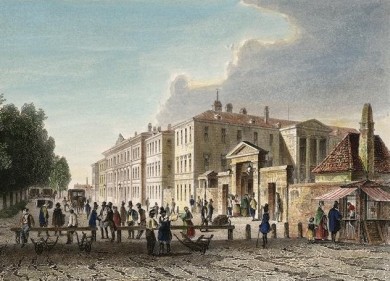
You are now entering the former grounds of Vienna's most important 19th-century railway station. The Nordbahnhof — terminus of the Kaiser Ferdinands Nordbahn — was built in 1839 and served as the Habsburg Empire's primary gateway to Bohemia, Moravia, and Silesia. Its grand hall, completed in 1865, was 137 metres long and considered the most magnificent station in Vienna.
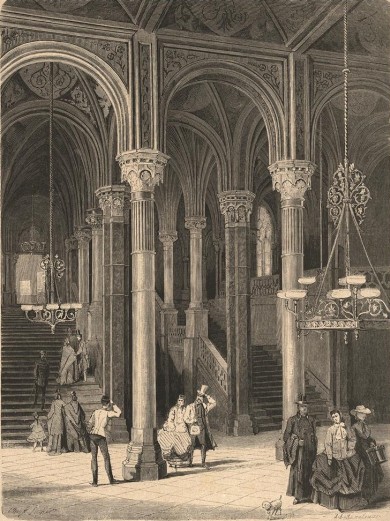
After the empire collapsed in 1918, the station lost its strategic relevance. During World War II, from 1943 onward, it served as a departure point for deportation transports of Vienna's Jewish citizens — a history commemorated at the Platz der Opfer der Deportation.
Severely damaged by bombing in 1944/45, the Nordbahnhof was never reopened. The ruined building stood for two decades — occasionally used as a film set — until it was demolished on 21 May 1965. The freight yard continued operating until around 2010.
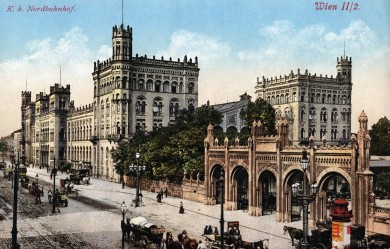
What remained was 85 hectares of inner-city brownfield — one of the largest urban development zones in Vienna. Look around you. Nothing remains of the station. The question for this district has always been: how do you build a neighbourhood on a site with no memory?
Timeline
Take a photo of what you see where the most magnificent station in Vienna once stood. What remains?
Upload to shared album →By uploading you agree to our photo consent terms.
Quiz