Station 5 · Circulum · Centrepiece
The
Ressourcencoup
📍 Wasserturm / Freie Mitte, 1020 Wien
Open in Google Maps — Wasserturm
Background
You are standing at the Wasserturm — a historic water tower that once supplied steam locomotives. It is the last surviving structure from the railway era and the gateway to the Freie Mitte.
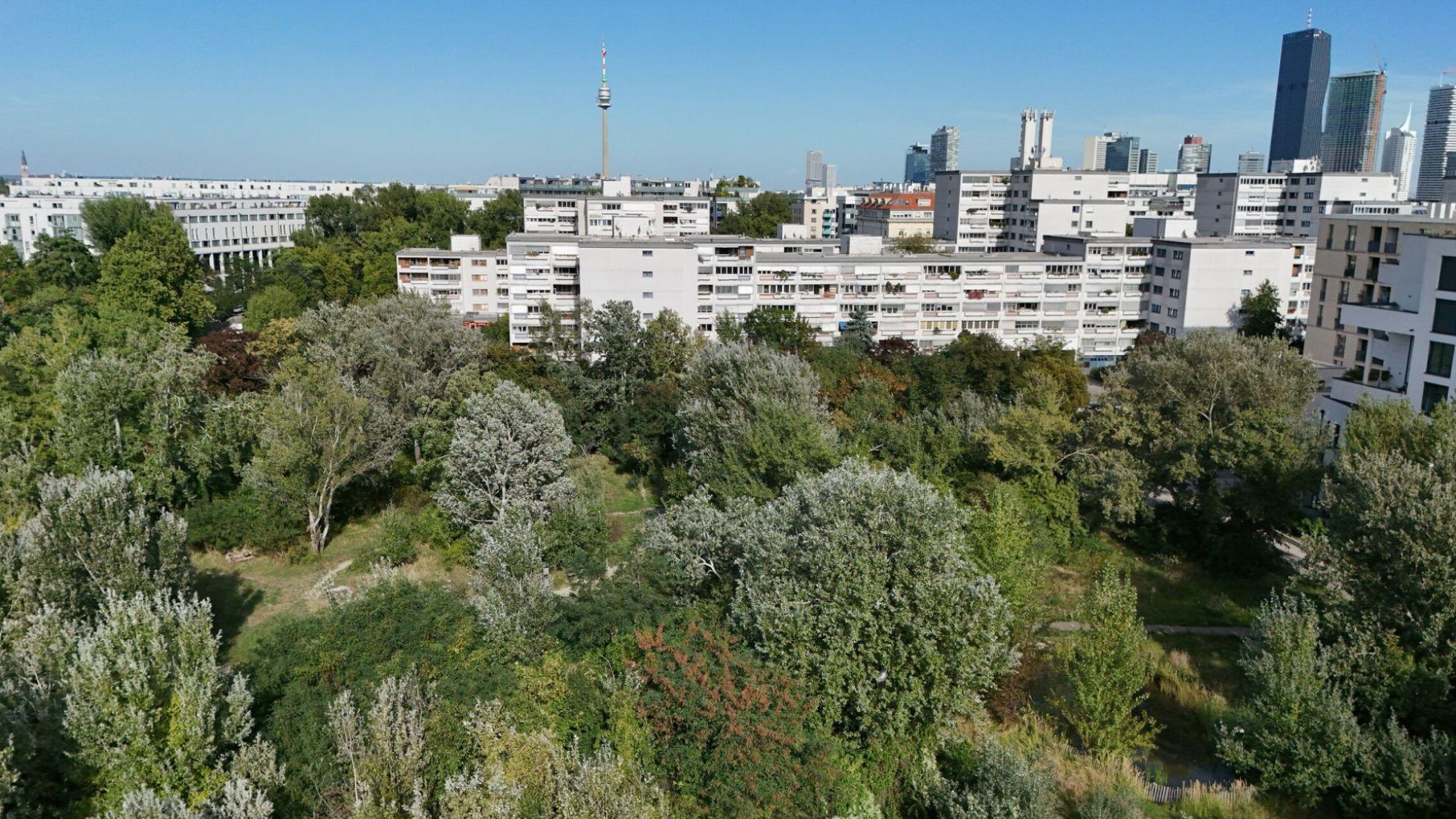
The Freie Mitte is a 10-hectare nature and recreation area. This is not a conventional park. It is a hybrid landscape combining wild urban nature, historic railway remnants, and designed public space. An area of urban wilderness — the Stadtwildnis — has been deliberately preserved, with wooden walkways providing access. One of Austria's oldest railway bridges is among the elements kept in place.

The centrepiece of the 2014 master plan "Freie Mitte — Vielseitiger Rand", designed by studioVlaY (Bernd Vlay and Lina Streeruwitz). Their concept inverted the usual logic: instead of building in the middle, density was pushed to the perimeter while the centre was kept radically open.
They called this the "Ressourcencoup" — a strategic reallocation. The compact edge makes the open centre economically viable. Not a luxury — a structural decision.
The plan was developed through citizen participation (2013–2014) called "Ein Grätzl stellt die Weichen". The STADTRAUM info centre attracted nearly 17,000 visitors (2017–2019).
In 2015, the ÖBB sold the remaining land to a consortium. This sale attracted criticism because it was conducted without a public tender.
Photograph the Freie Mitte — what surprises you about finding this in the middle of a city?
Upload to shared album →By uploading you agree to our photo consent terms.
Quiz
You are the city councillor responsible for urban development. A developer offers €200M for the 10-hectare Freie Mitte — to build premium towers with 3,000 apartments.
Citizens demand a public park. Climate experts need green cooling corridors. Your budget is under pressure.
What is your decision? 3–5 sentences.
Fictional scenario. No "correct" answer — weigh financial, social, ecological, political interests.