The Problem
Tame vs. Wicked
The most fundamental distinction on Pneuma Circularis is between two kinds of problems. Tame problems have clear definitions, testable solutions, and stopping rules. You know when you have solved them. Engineering optimisations are tame. Chess is tame.
But the problems that matter most are not tame. They are wicked.
In 1973, Horst Rittel and Melvin Webber identified ten properties that make certain problems resistant to technical-rational approaches. You cannot solve them by gathering more data. You cannot solve them by applying expert knowledge. They demand different methods entirely.
The Ten Properties (Rittel & Webber, 1973)
No definitive formulation — the problem specification is inseparable from the solution specification
No stopping rule — there is no inherent logic that signals when the problem is solved
Solutions are not true or false, but good or bad — judgements, not proofs
No immediate test — you cannot run controlled experiments; every intervention has lasting effects
Every solution is a one-shot operation — no trial-and-error, because every attempt counts
No enumerable set of potential solutions — the solution space is open-ended and infinite
Every wicked problem is essentially unique — past solutions provide insight but not blueprints
Every wicked problem is a symptom of another problem — causation traces upward indefinitely
Multiple explanations for the same discrepancy — different stakeholders see different problems
The planner has no right to be wrong — interventions affect real lives
The Gliding Scale
Not every problem is purely tame or purely wicked. The Gliding Scale positions challenges on a continuum, assessed through the morphological method (Zwicky) applied to the ten properties (Rittel & Webber).
Clear definition, testable, repeatableUnique, irreversible, contested
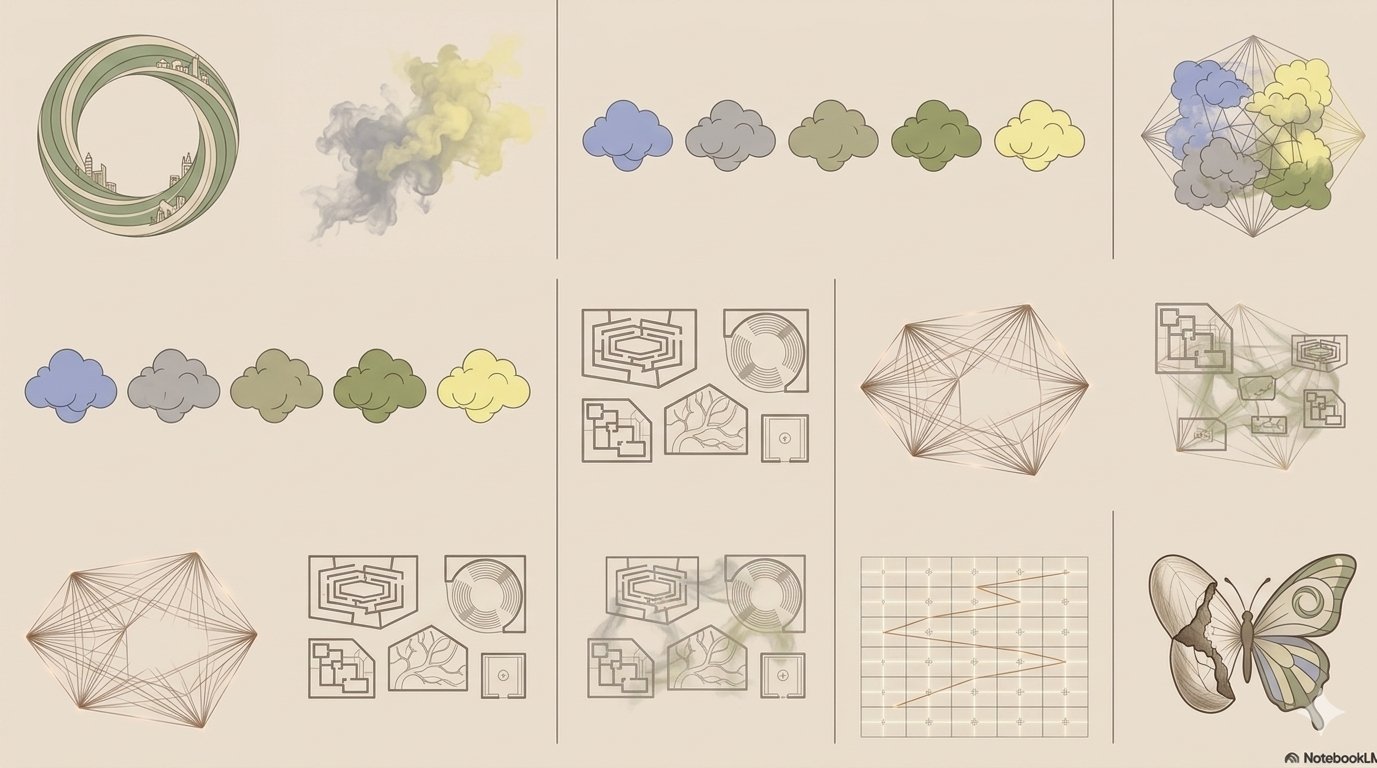
The design vocabulary of WICKED: morphological fields, Delaunay networks, cloud nation sequences, system diagrams, metamorphosis. © Dr.techn. Anna-Vera Deinhammer, Google NotebookLM.
The Method
W — I — C — K — E — D
The name is the method. Each letter is a step in navigating wicked problems:
W
Wicked Problem Framing
Is this actually a wicked problem? Test it against Rittel's properties. If yes: activate the full method. If no: use conventional problem-solving.
I
Interests Mapping
Map stakeholders and their interests — visible and hidden. Conflicts and synergies. Veto power, champions, blockers. Who benefits? Who is harmed? Whose voice is not in the room?
C
Criteria Constellation
Identify evaluation criteria. Accept that different stakeholders have different criteria sets: economic viability, ecological sustainability, social justice, cultural identity, aesthetic quality, technical feasibility. Hold the tension between incommensurable values.
K
Knowledge Gaps
What do we not know? Distinguish critical gaps (need research before deciding), acceptable gaps (can be managed with heuristics), and irreducible gaps (genuine uncertainty that cannot be resolved).
E
Exploration of Options
Generate the morphological space of possible solutions using Fritz Zwicky's method. Systematic exploration of ALL combinations — not optimisation of the first plausible option.
D
Decision with Protopian Compass
Recommend the option that keeps the most future options open (von Foerster's ethical imperative), enables incremental improvement across multiple time scales (Protopia), resonates with natural systems (circularity), and avoids the worst potential harms (precautionary principle).
The Implementation
Four Layers of the Tool
The six steps above are operationalised through four methodological layers — the instruments AnaVienna reaches for when activating the WICKED method:
Layer One
The Morphological Box
Fritz Zwicky
Before solving, understand the full dimensionality. Identify independent parameters — the fundamental dimensions along which solutions can vary. Enumerate all possible values exhaustively. Not just the practical ones. All of them. Use Cross-Consistency Assessment to identify coherent, feasible, acceptable configurations. The morphological box does not give you the answer. It gives you the complete menu of possible answers.
Layer Two
The AHP/ANP Prioritiser
Thomas Saaty
Once you have the feasible solution space: how do you choose? Saaty's Analytical Hierarchy Process converts qualitative judgements into quantified priorities through systematic pairwise comparison. The mathematics (eigenvalue decomposition) ensures consistency. The method makes everyone's reasoning explicit — it helps groups converge on choices even when members have different values.
Layer Three
The Syntonie Spheres Navigator
Alexander Laszlo
You have identified and prioritised solutions. Now check: does your preferred solution work across all five spheres? For individuals? Communities? Non-human systems? Future generations? The cosmos? Many solutions optimise one sphere while damaging others. The Navigator forces hard questions: whose interests are served? Whose are harmed? Which trade-offs are conscious, which unconscious?
Layer Four
The Bridge Check
Zev Paiss
One question remains: can people actually walk across this bridge? Vision without a plausible path accomplishes nothing. People will not leave the familiar for the sake of what could be unless they see a credible way from here to there.
The Three Dimensions of the Bridge
Sustainable
Does this expand future options rather than limiting them? (Von Foerster's imperative.) Does it provide direction and legitimacy for lasting change?
Smart
Do we have the tools to implement this? Can we access the data? Is the technology ready? Technology provides visibility and scalability.
Circular
Is this concrete enough that people can see it and touch it? Can they imagine participating? Circularity makes vision physically manifest.
These three dimensions reinforce each other. Together they form a plausible bridge that industries can cross, investors can trust, and people can walk across.
Application
How AnaVienna Uses the Tool
When facing a wicked problem — the circular economy gap in Austrian construction, the future of an alpine resort, the alignment of EU Taxonomy criteria across climate zones — AnaVienna does not immediately propose solutions. She activates the Tool:
Identify parameters. What are the independent dimensions? Energy system, mobility, building stock, social structure, governance, financing, adaptation strategy.
Enumerate values. For each parameter, the full range of possibilities. Not just obvious ones. This is the morphological phase — exhaustive, systematic, refusing to narrow prematurely.
Cross-Consistency Assessment. Which combinations are logically coherent? Empirically feasible? Normatively acceptable to stakeholders?
Prioritise (AHP/ANP). Among viable configurations, which best serve the articulated criteria? Where is consensus? Where is irreducible disagreement?
Navigate the five Spheres. Does the preferred solution work across all spheres? Where are the trade-offs? Are they conscious or unconscious?
Bridge Check. Sustainable enough for direction? Smart enough for tools? Circular enough for trust?
And then she does not present "the solution." She presents the next intelligent step. The protopian move. The 1% improvement that moves the system toward a more viable configuration without requiring a revolutionary leap that no one will take.
This is how you work with wicked problems. Not by solving them. By engaging with them skillfully, mapping their full dimensionality, making interventions that expand rather than foreclose future options, learning as you go, building the bridge as you walk across it.
Sources: Rittel, H. W. J. & Webber, M. M. (1973). Dilemmas in a General Theory of Planning. Policy Sciences, 4(2), 155–169. · Zwicky, F. (1969). Discovery, Invention, Research through the Morphological Approach. Macmillan. · von Foerster, H. (2003). Understanding Understanding. Springer. · Meadows, D. H. (2008). Thinking in Systems. Chelsea Green. · Kelly, K. (2016). The Inevitable. Viking. · Huber-Heim, K., Laszlo, A. & Deinhammer, A.-V. (2025). Governing the Transition to Circular Economy and Liveable Cities. In: Brears (Ed.), The Circular Economy and Liveable Cities. Cambridge University Press.